
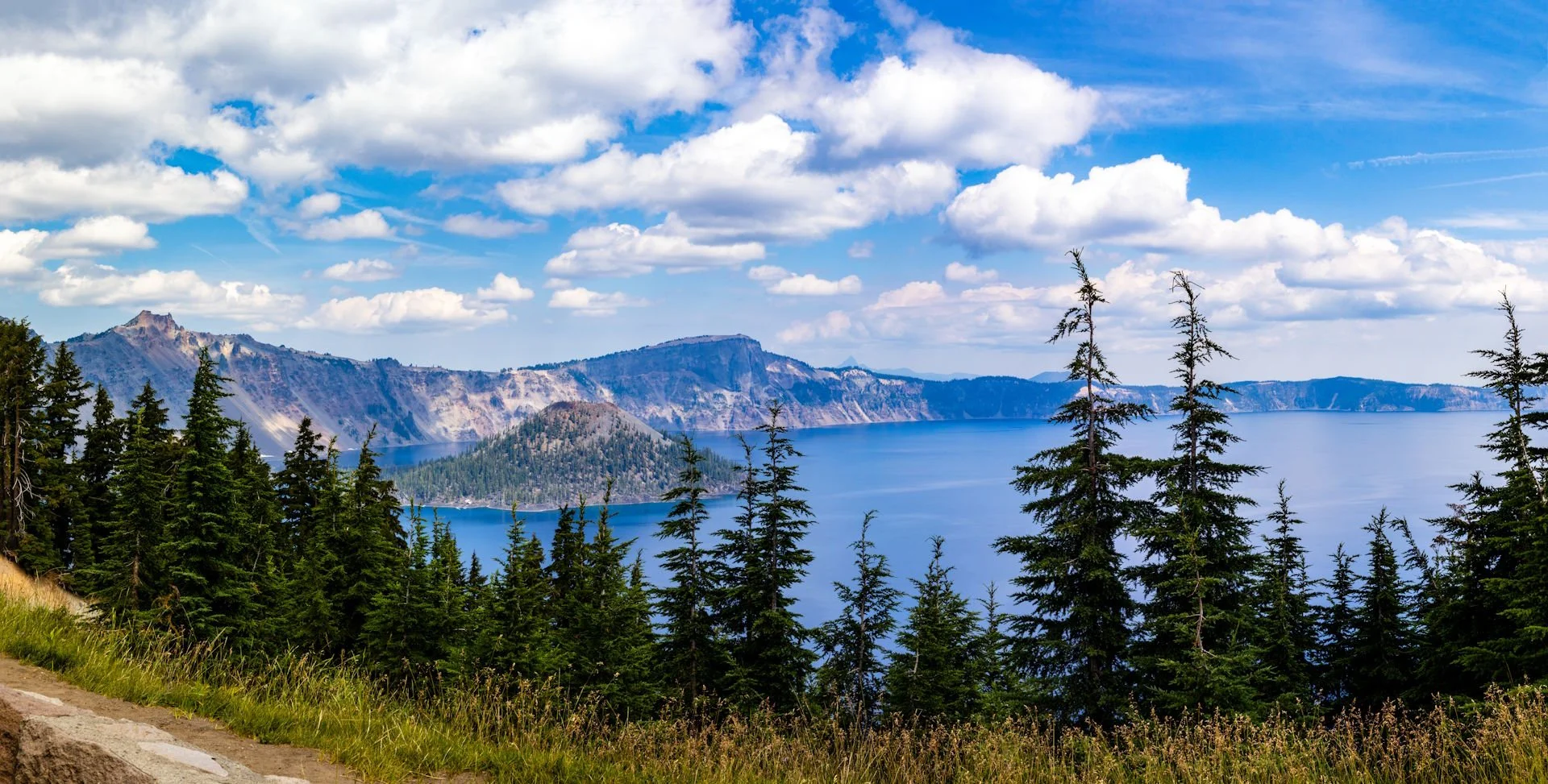
Crater Lake National Park
Crater Lake sits inside the collapsed remains of Mount Mazama, one of many volcanos in the Cascade range. About 7,700 years ago, Mount Mazama unleashed a massive explosive eruption. As the magma chamber emptied, the peak of the mountain collapsed, leaving a broad caldera roughly 5–6 miles across.
Crater Lake, Oregon
It was shaping up to be another hot 100+ degree day in the Rogue River Valley where I was staying when we set out for majestic Crater Lake National Park in early August 2023. After a short drive up Hwy 62 through the Oregon countryside we soon found our selves working our way up the winding mountain road to the visitor center. When we arrived at Rim Village on the rim of the lake it was a beautiful 72 degrees, with puffy white clouds scattered across the sky. Unfortunately, there was a bit of a haze looking out across the lake that day from the wildfires burning out to the west, but as always the view was worth the trip none the less.
I captured the photos that make up this panorama using my Canon M50 Mark II with the 15-45mm kit lens @ 28mm. The final image is made up of 8 photos which were stitched together and edited in Lightroom.
Background
Crater Lake sits inside the collapsed remains of Mount Mazama, one of many volcanos in the Cascade range. About 7,700 years ago, Mount Mazama unleashed a massive explosive eruption. As the magma chamber emptied, the peak of the mountain collapsed, leaving a broad caldera roughly 5–6 miles across. Subsequent eruptions built up the cinder cone inside the caldera that we now see and know as Wizard Island. Over time, rain and snow filled that basin, creating today’s lake which is famous for its deep blue color and clarity because it’s fed entirely by precipitation rather than rivers bringing in sediment.
Wizard Island
Facts About Crater Lake
It’s the deepest lake in the United States @ ~1,943 ft deep.
One of the clearest lakes in the United States. Water clarity averages around 102 ft as measured using standard clarity methods like a Secchi disk. That means you can see a 6 inch disk over 100ft below the surface of the water!
The caldera walls around the lake rise up to ~2,000 ft above the water’s surface in places.
The lake surface sits around 6,178 ft above sea level.